
Aerolase at 30: How One Engineering Decision Changed Laser Dermatology

When Aerolase was founded in 1996, the aesthetic laser industry had a skin tone problem — and most companies had quietly decided to live with it.
Conventional millisecond-pulse lasers generated thermal diffusion patterns that created unacceptable risk for patients with darker Fitzpatrick skin types: hyperpigmentation, burns, scarring. The standard response was to treat this as a clinical limitation. Aerolase treated it as an engineering problem worth solving.
Three decades later, that decision defines the company — and has quietly reshaped a standard of care.
What makes Aerolase's technology different?
The core innovation is pulse duration. While the industry operated in the millisecond range, Aerolase spent nearly a decade engineering a 650-microsecond Nd:YAG laser — a pulse window deliberately positioned between nanosecond and millisecond domains.
This wasn't incremental refinement. It was a fundamental rethinking of how laser energy interacts with tissue.
By operating at 650 microseconds, the platform achieves selective photothermolysis — heating the target chromophore while dramatically reducing collateral thermal damage to surrounding epidermis. The result is a laser that can treat vascular, pigmented, and inflammatory targets with minimal risk of post-inflammatory hyperpigmentation (PIH), even in Fitzpatrick skin types IV through VI.
The company received FDA 510(k) clearance in 2000 and expanded its cleared indications through 2004, laying the foundation for the Neo Elite and Era Elite platforms that practitioners use today.
The Aerolase device portfolio
Aerolase's clinical depth comes from three complementary platforms:
Neo Elite — 1064nm Nd:YAG (650-microsecond pulse) Optimized for deep dermal and vascular targets. Indicated for acne, melasma, rosacea, pseudofolliculitis barbae (PFB), onychomycosis, skin laxity, hair removal, vascular lesions, and more — across all Fitzpatrick skin types.
Era Elite — 2940nm Er:YAG (300-microsecond pulse) Engineered for controlled, full-ablative resurfacing. Indicated for deep wrinkles, acne scars, skin texture, and photoaging.
Exci308 — 308nm Excimer added in 2022, extending Aerolase's reach into targeted phototherapy for autoimmune skin conditions including vitiligo and psoriasis.
Together, the portfolio covers more than 36 FDA-cleared indications — delivered through a contact-free handpiece that requires no consumables, no anesthesia, and minimal downtime.
Why all skin types matter (and why most lasers still don't treat them well)
This is a question the industry has not fully answered.
The physics are straightforward: melanin is a competing chromophore. When a laser fires at a melanin-rich target — a pigmented lesion, a hair follicle, an inflamed sebaceous gland — epidermal melanin in darker skin types absorbs competing energy, creating heat in tissue that isn't the target. Longer pulse durations increase the window for that heat to diffuse and damage surrounding structures.
Shorter pulse durations reduce that window. Aerolase's 650-microsecond pulse sits in the range where the energy has transferred to the target before significant thermal diffusion occurs — preserving the integrity of the surrounding epidermis.
The global demographic stakes are significant. By 2050, projections indicate that over 85% of the world's population will have skin of color1. As that shift accelerates, the ability to treat darker skin types safely will move from a competitive differentiator to a baseline clinical requirement. Meanwhile, the global medical laser market is projected to exceed $27 billion by 20352, driven in part by rising demand for treatments that serve increasingly diverse patient populations.
The clinical validation behind the technology
Aerolase's commercial expansion followed, rather than preceded, its clinical validation.
Between 2006 and 2015 — before large-scale market presence — leading U.S. dermatologists including Michael Gold, MD, and David Goldberg, MD adopted the platform and conducted independent case studies across diverse patient populations. International distributors entered the market on the strength of published results.
A medical advisory board of leading dermatologists was in place by 2015. The Neo Elite and Era Elite commercial platforms launched in 2018. The sequence was intentional: prove the science first, then build the infrastructure around it.
Today, Aerolase technology is used in more than 70 countries.
1. Campbell-Stephens RM. Educational Leadership and the Global Majority: Decolonising Narratives. Palgrave Macmillan; 2021. https://doi.org/10.1007/978-3-030-88282-2
2. Precedence Research. Medical Laser Market Size to Hit USD 27.15 Billion by 2035. December 2024. https://www.precedenceresearch.com/medical-laser-market
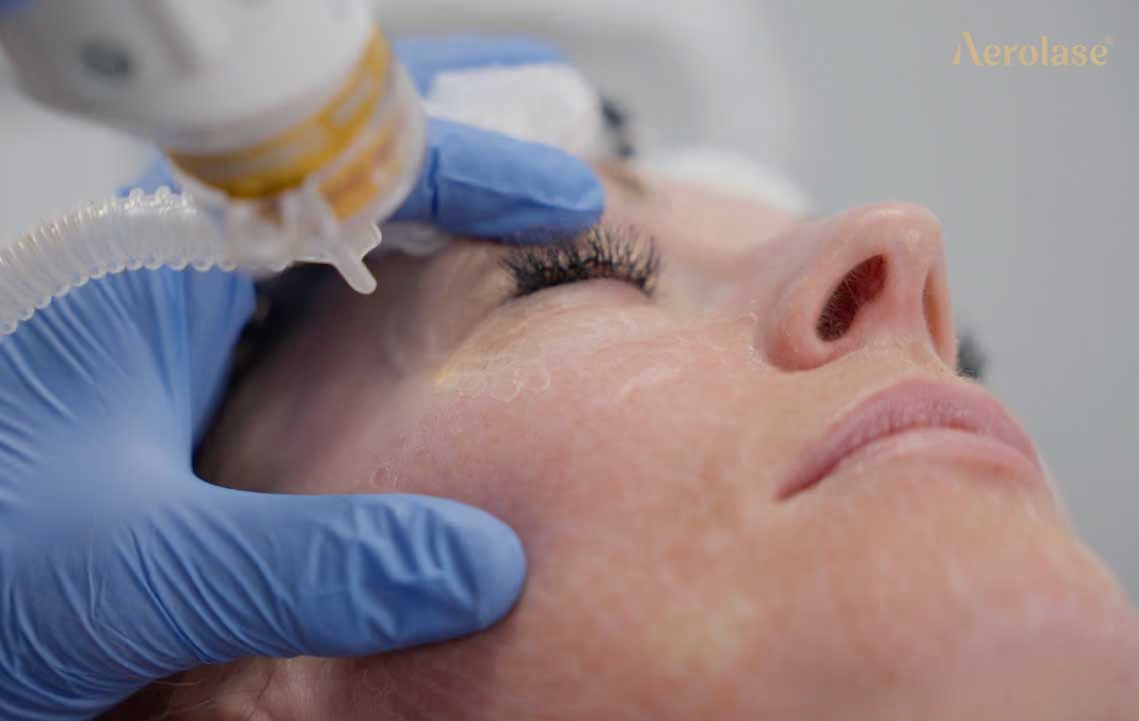
Treating Crow's Feet and Perioral Lines with Precision: Dr. James Gordon on the Era Elite 6mm Lens
Oculoplastic surgeon Dr. James Gordon explains how the Aerolase Era Elite 6mm lens delivers targeted 2940nm Er:YAG resurfacing for crow's feet and perioral lines.

Aerolase Skin Health Summit | Toronto Recap
Aerolase hosted its inaugural Skin Health Summit in Toronto, bringing together leading physicians, aesthetic practitioners, and industry experts for a day of education, live laser demonstrations, and clinical collaboration.

How Hybrid Fractional Resurfacing Treats Acne Scars: A Clinical Walkthrough with Dr. James Gordon
Oculofacial Plastic Surgeon Dr. James Gordon explains how the Aerolase Era Elite hybrid fractional lens disrupts fibrotic scar tissue and stimulates collagen — and what practitioners and patients should know about the treatment.