
How to Choose a Dermatology Laser in 2026
A laser platform is one of the largest capital decisions a dermatology or aesthetic practice makes, and it is one of the few that constrains clinical capability for the next five to seven years. The device you sign for in 2026 determines which conditions you can treat, which patients you can treat safely, how many chairs you can turn in a day, and how much of each treatment fee survives after consumables and service.
Most buying processes get run backward. A rep books a demo, the platform looks impressive, the financing is manageable, and the decision gets made on the strength of the demo rather than the strength of the fit. The result is a familiar pattern: a device that performs one indication well, sits idle between cases, and requires a second purchase eighteen months later to cover what it cannot.
This guide reverses the order. Start with your patient population, work outward to wavelength and pulse structure, then pressure-test the economics before anyone discusses price.
Step 1: Map your indications before you evaluate any platform
Pull twelve months of encounter data and rank your treatable conditions by volume, not by margin. Most practices are surprised by what surfaces. The list usually includes some combination of acne and acne sequelae, post-inflammatory hyperpigmentation, melasma, rosacea and facial erythema, benign vascular lesions, onychomycosis, pseudofolliculitis barbae, hair reduction, photodamage, and general skin quality and tone requests.
Then separate that list into three tiers:
Tier 1: high volume, currently treated. Conditions you already manage with topicals, orals, or an existing device. A new platform has to improve outcomes, reduce visit count, or reduce cost per treatment on these, or it adds nothing.
Tier 2: high volume, currently referred out or declined. This is where new revenue lives. If you are turning away Fitzpatrick IV-VI patients for pigment or vascular work because your current device is not safe on their skin, that is a quantifiable gap.
Tier 3: emerging demand. Requests you are seeing more of but have not built a service line around.
A platform that covers Tier 1 and Tier 2 with a single handpiece is worth more than a platform that covers Tier 1 brilliantly and nothing else, even at a higher price. Utilization is the variable that determines return, and utilization is a function of indication breadth.
Step 2: Understand what each wavelength actually does
Wavelength determines which chromophore absorbs the energy and how deep the energy travels. Everything else in the specification sheet is secondary to this.
532 nm (KTP): Strong absorption by oxyhemoglobin and melanin. Excellent for superficial vascular lesions and epidermal pigment in lighter skin. Melanin competition makes it high risk in Fitzpatrick IV and above.
755 nm (alexandrite): High melanin affinity. Effective for hair reduction and epidermal pigment in lighter skin types. The same melanin affinity that drives efficacy drives epidermal injury risk in richly pigmented skin.
810 nm (diode): The conventional hair reduction workhorse. Moderate melanin absorption, moderate depth. Contact cooling is typically mandatory.
1064 nm (Nd:YAG): The lowest melanin absorption of the commonly used aesthetic wavelengths and the deepest penetration. Targets deoxyhemoglobin, water, and, at appropriate pulse structures, sebaceous glands and follicular units. This is the wavelength that makes Fitzpatrick I through VI treatment achievable on a single device, which is why it anchors most multi-condition platforms. See how 1064nm behaves in tissue.
1550 nm and 1927 nm (non-ablative fractional): Water-targeted resurfacing. The 1927 nm thulium range is used for epidermal pigment and melasma protocols.
2940 nm (Er:YAG) and 10,600 nm (CO2): Ablative resurfacing. High efficacy, meaningful downtime, and elevated PIH risk in darker phototypes.
Er:YAG Resurfacing Overview
Aerolase Controlled Ablation Er: YAG Platform
308 nm (excimer): Targeted phototherapy for psoriasis, vitiligo, and atopic dermatitis. A distinct medical service line rather than an aesthetic one, and worth evaluating separately if your payer mix supports it. 308nm excimer in autoimmune dermatology.
The practical takeaway: if your patient population spans the full Fitzpatrick range, a 1064 nm platform should be the center of your evaluation, with additional wavelengths added only where a documented Tier 1 or Tier 2 gap justifies them.
Step 3: Evaluate pulse duration, not just wavelength
Wavelength selects the target. Pulse duration determines whether you heat that target without heating the tissue around it.
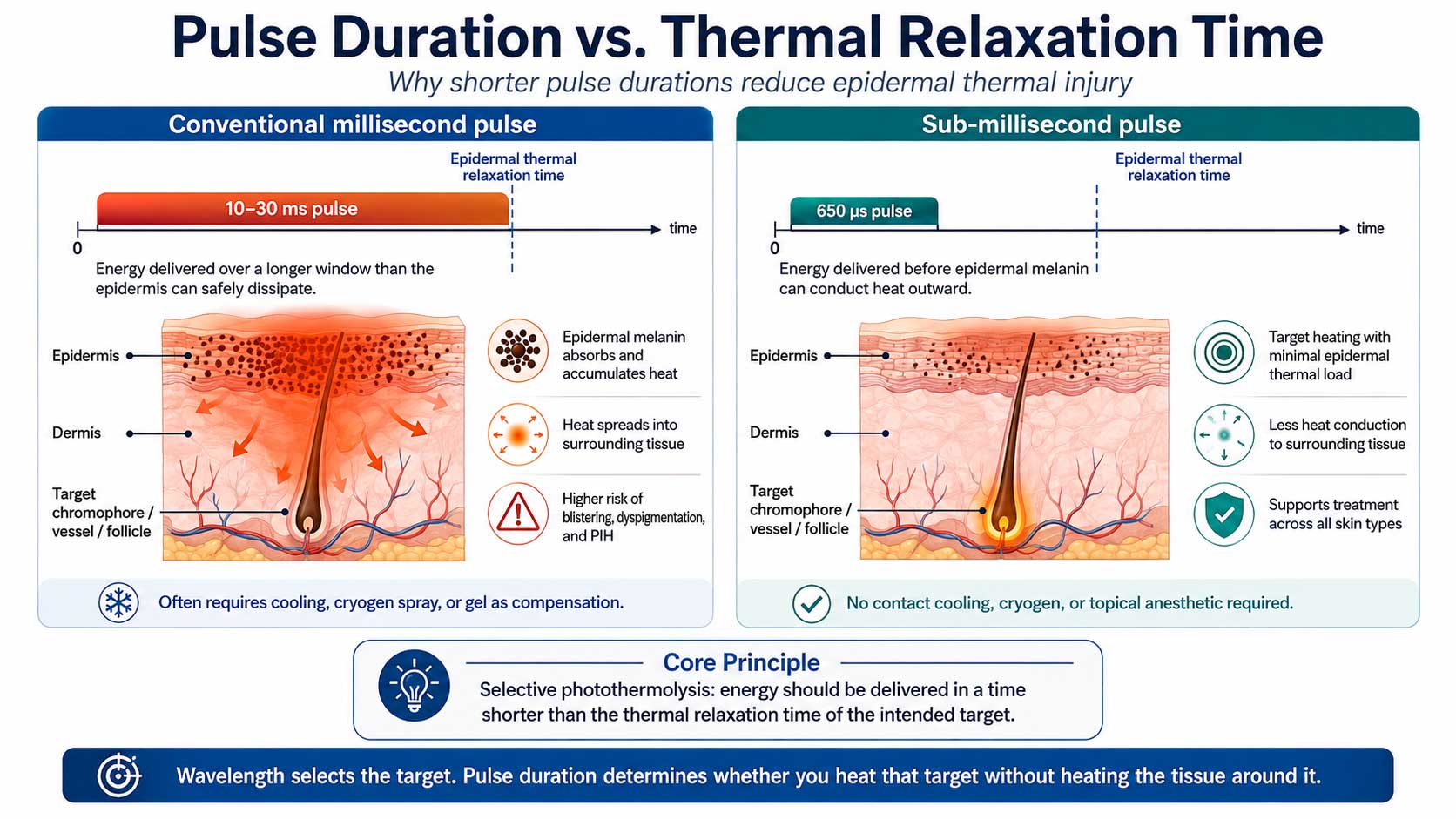
Selective photothermolysis holds that energy must be delivered in a time shorter than the thermal relaxation time of the intended target. The epidermis, packed with melanin in richly pigmented skin, has a short thermal relaxation time. Millisecond pulses deliver energy over a window long enough for epidermal melanin to absorb, accumulate, and conduct heat into surrounding tissue. That is the mechanism behind blistering, dyspigmentation, and PIH in Fitzpatrick IV-VI, and it is why most legacy systems require contact cooling, cryogen spray, or gel as a compensating measure.
Sub-millisecond pulse structures change the calculation. Delivering the same fluence in 650 microseconds rather than 10 to 30 milliseconds means the energy is deposited faster than epidermal melanin can conduct heat outward. The result is target heating with minimal epidermal thermal load, which is what allows a device to treat across all skin types without contact cooling, cryogen, or topical anesthetic.
Three questions to ask any vendor here:
- What is the pulse duration range, expressed in microseconds or milliseconds?
- Is contact cooling, cryogen, or gel required for safe treatment in Fitzpatrick V and VI?
- What is the fluence range at each spot size, and what is the repetition rate at clinical settings?
Step 4: Verify skin type safety with evidence, not marketing claims
"Safe for all skin types" appears in nearly every brochure. Ask for the substantiation.
Request the FDA 510(k) clearance list by indication. Clearances are indication-specific, and marketing claims routinely outrun them. A device cleared for hair reduction is not cleared for acne, and a rep who blurs that line is a liability during an audit. You can verify any manufacturers clearances yourself in the FDA 510 (k) premarket notification database.
Request peer-reviewed data that includes Fitzpatrick IV-VI subjects specifically. Studies that enroll predominantly type II and III patients and conclude the device is "well tolerated" tell you nothing about performance in the population you are trying to serve. Laser parameter considerations by Fitzpatrick phototype.
Request adverse event experience. Ask directly what the PIH rate looks like in darker phototypes, what parameters were used, and what the recovery protocol is when it occurs.
Step 5: Model total cost of ownership, not purchase price
Purchase price is the smallest number in this calculation. Build the five-year model.
Consumables
Disposable tips, cryogen canisters, gels, and single-use handpiece components. Calculate cost per treatment, then multiply by projected annual volume. A platform with a lower sticker price and a per-treatment consumable cost can exceed a higher-priced consumable-free system within two years.
Service contracts
Annual coverage typically runs a meaningful percentage of purchase price. Ask what is included, what is excluded, what the response time commitment is, and whether a loaner is provided during repair.
Handpiece and component life
Ask for expected pulse counts before refurbishment or replacement, and the cost of each.
Calibration and downtime
Ask how often calibration is required, whether it can be performed in-house, and what documented average uptime looks like across the installed base.
Facility requirements
Electrical service, water cooling, footprint, ventilation, plume evacuation, and room dedication. A device requiring 208V service and a dedicated room carries build-out cost that never appears on the quote.
Staffing and licensure
Delegation rules vary by state and directly affect throughput economics. A device that a trained clinical staff member can operate under your supervision produces materially different margin than one requiring physician time for every pulse.
Step 6: Treat throughput as a clinical specification
Chair time is the constraint that governs practice capacity. Two devices with equivalent clinical outcomes can produce very different annual revenue if one requires a 45-minute appointment and the other requires 15.
Ask what the full appointment looks like, not the pulse time. Include topical anesthetic wait, cooling setup, treatment, and post-treatment care. A protocol requiring 30 to 45 minutes of numbing before the laser is ever fired consumes a room and a staff member before treatment begins.
Ask about treatment series length. A protocol that resolves an indication in four visits versus six changes both patient adherence and schedule load.
Ask about post-treatment restrictions. Downtime is a clinical variable, but it is also a scheduling and rebooking variable. Protocols that allow patients to return to normal activity immediately produce better series completion rates, and series completion is what turns a treatment into revenue.
Step 7: Assess the platform, not the demo
Demos are engineered to succeed. Structure yours to be informative instead.
Bring your own cases. Ask to treat, or observe treatment of, patients who reflect your actual population, including Fitzpatrick IV-VI, active inflammatory acne, and mixed pigment presentations.
Ask for a peer reference in your specialty and your market. Then call them without the rep on the line. Ask what breaks, how fast it gets fixed, and what they wish they had asked before signing.
Evaluate training depth. Ask what initial training includes, whether it is on-site, how many staff are covered, what ongoing education is available, and what happens when you hire someone new in year three. Clinical education and webinar library.
Evaluate clinical support. Ask who you call when a case does not respond and how quickly a clinical specialist can be reached.
Ask about trial and rental programs. Several manufacturers now offer rental or placement structures that let you validate demand before committing capital. If a platform is a genuine fit, a trial period will confirm it. If a vendor resists the idea entirely, weigh that. Rental and placement program
The vendor question checklist
Bring this to every evaluation:
- What wavelengths does the platform deliver, and what is the pulse duration range for each?
- Which FDA 510(k) clearances does this device hold, by indication?
- Is contact cooling, cryogen, or topical anesthetic required for Fitzpatrick V and VI treatment?
- What peer-reviewed data exists with Fitzpatrick IV-VI subjects?
- What is the per-treatment consumable cost?
- What does the annual service contract cost and cover, and is a loaner included?
- What is the expected handpiece life in pulses, and the replacement cost?
- What are the electrical, cooling, and space requirements?
- What is the average appointment length per indication, including preparation?
- Can trained clinical staff operate this device under supervision in my state?
- What training is included initially, and what is available ongoing?
- Can I speak with three current users in practices similar to mine?
Making the decision
The strongest evaluations share a pattern. They start with documented patient demand rather than device capability. They treat pulse duration and skin type safety as clinical requirements rather than specification-sheet detail. They model five-year cost rather than purchase price. And they verify claims against clearances, published data, and peer references before signing.
A platform that treats a broad indication set safely across every skin type in your patient population, in appointment windows your schedule can absorb, without consumable cost on every pulse, will outperform a more specialized device on nearly every measure that matters over a five-year horizon.
Build the model first. The right platform will be obvious once the numbers are in front of you.

1064 nm Nd:YAG has the lowest melanin absorption of the commonly used aesthetic wavelengths, which makes it the most widely used option for treating Fitzpatrick I through VI on a single platform. Safety in darker phototypes also depends on pulse duration, not wavelength alone.
For most practices, yes, because return is driven by utilization. A platform covering several high-volume indications generates revenue across more of the schedule than a device tied to one service line. Single-indication devices make sense when volume in that indication alone justifies the capital.
Not necessarily. Platforms operating at 1064 nm with appropriate pulse structures address vascular, pigment, and inflammatory acne indications from one handpiece. Verify the specific FDA clearances rather than relying on category claims.
The variables are utilization rate, cost per treatment, appointment length, and series completion. Practices that build a protocol and a patient pipeline before delivery reach return substantially faster than practices that install first and market later.
Purchase price varies widely by platform and configuration. The more useful figure is five-year total cost of ownership, which includes consumables, service contracts, component replacement, facility requirements, and staffing. Build that model before comparing quotes.

Pavel Efremkin of Aerolase On The Future Of Beauty
Aerolase founder and CEO Pavel Efremkin, PhD, shares the engineering breakthroughs, clinical philosophy, and vision behind Aerolase — and where laser skin health is headed next.

Thirty Years of Redefining Dermatological Laser Technology
Aerolase founder Pavel Efremkin shares the 30-year journey behind pioneering 650-microsecond pulse technology, transforming dermatological lasers with pain-free treatments safe for all skin types.

Aerolase Wins 2025 MedEsthetics Readers' Choice Awards: Neo Elite Named Best Acne Device, Era Elite Recognized for Laser Skin Resurfacing
Aerolase Neo Elite wins Best Acne Device and Era Elite named finalist for Best Laser Skin Resurfacing in 2025 MedEsthetics Readers' Choice Awards.